
How to Read Vitamin and Supplement Labels Before Buying
Introduction
Knowing how to read vitamin and supplement labels helps you make more informed decisions when shopping for vitamins, minerals and nutritional products. Whether you live in Italy, Germany, France, Spain or another European country, checking the label before purchasing can help you understand what a supplement contains, how it should be used and what precautions may apply.
Product packaging can include many details, from ingredient lists and serving sizes to nutrient quantities, storage instructions and warnings. Marketing terms on the front of a bottle do not tell you everything you need to know.
At NewLife Health Vitamins, we encourage customers to review product information carefully, compare products responsibly and ask questions when something is unclear.
This guide explains the main parts of a supplement label and what European customers should check before buying.
1. Check what the product is designed to provide
Start by reading the product name and description. Determine whether the product is a multivitamin, a single-nutrient supplement, an omega-3 product, a nutritional shake or another type of food supplement.
For example, a product may contain vitamin D, magnesium, omega-3 fatty acids or a combination of vitamins and minerals. These products are not interchangeable because their ingredients and intended nutritional purposes can differ.
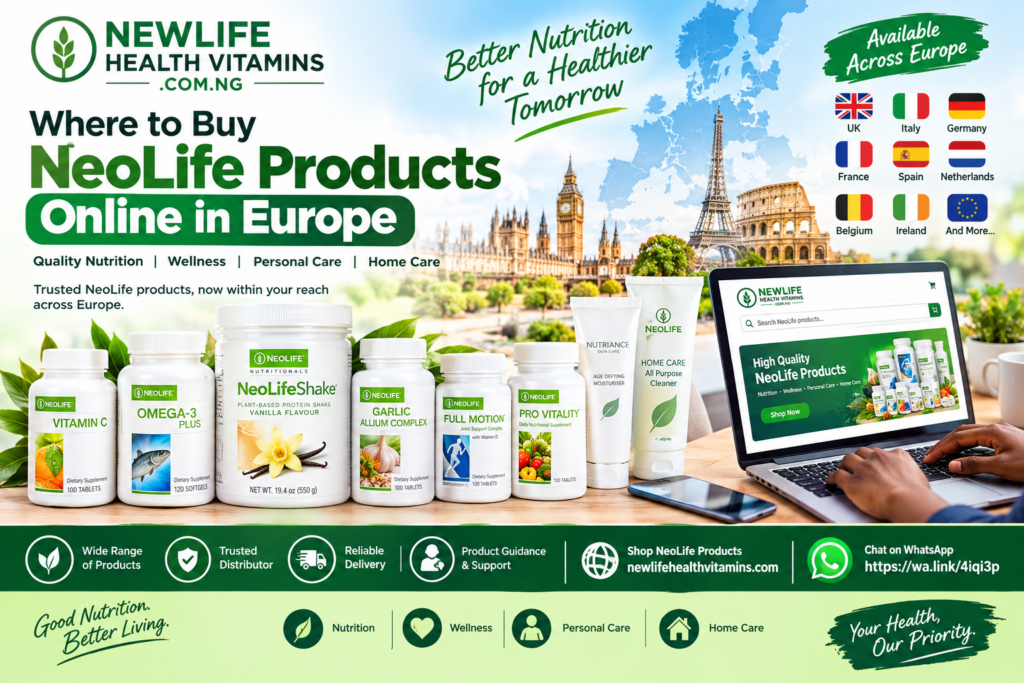
If you are exploring NeoLife nutrition products, review the current product label and description rather than relying only on the brand name or a social media post.
Ask yourself:
- Which nutrients or other ingredients does this product contain?
- Does the ingredient list match what I am looking for?
- Do I understand the product’s intended use?
- Is the product suitable for my age group and circumstances?
Remember that food supplements are intended to complement the diet, not replace a varied and balanced eating pattern.
2. Read the serving size and recommended daily dose
The serving size tells you how much product the listed nutrient amounts relate to. A serving might be one tablet, two capsules, a measured scoop of powder or a specified amount of liquid.
Do not assume that one capsule always equals one recommended daily serving.
Check these details:
- Serving size: The amount used for the stated nutrient information.
- Recommended daily portion: The amount the manufacturer advises taking each day.
- Directions for use: Whether the product should be taken with food, mixed with liquid or prepared in a particular way.
- Warnings: Any instructions or restrictions that apply to the product.
EU food-supplement rules require the recommended daily portion and a warning not to exceed the stated daily dose. They also require statements that supplements should not replace a varied diet and should be kept out of the reach of young children. Check the actual packaging for the wording applicable to the product and market.
Never take more than the label recommends simply because you want faster results.
3. Understand nutrient amounts and percentages
One of the most useful parts of a vitamin or mineral label is the table showing the amount of each nutrient in a serving.
You may see quantities expressed in different units, including:
- mg (milligrams): One-thousandth of a gram.
- µg (micrograms): One-millionth of a gram.
- g (grams): A larger unit commonly used for ingredients such as protein or carbohydrates.
- % NRV: The percentage of the Nutrient Reference Value provided by the stated serving, where this information is given.
For example, a hypothetical label might show a vitamin providing 10 µg per serving and a percentage NRV. That figure tells you how the amount compares with the applicable reference value used for labelling; it does not automatically tell you whether you personally need the supplement.
Nutrient needs vary according to factors such as age, diet and life stage. European Food Safety Authority reference values help inform nutrition guidance and labelling, but they are not personalised recommendations for every individual.
You can learn more from the European Food Safety Authority’s guidance on dietary reference values.
4. Examine the full ingredients list
The front of a package may highlight one or two key nutrients, but the ingredients list provides a broader picture of what is in the product.
Look for:
- Active nutrients, such as vitamins and minerals.
- Plant extracts or other ingredients.
- Fillers, binders, coatings or other formulation ingredients, where applicable.
- Sweeteners, flavourings or allergens, if present.
- Any ingredient you have been advised to avoid.
If you have a food allergy or intolerance, read the complete ingredient and allergen information every time you purchase a product. Formulations and packaging can change.
If you do not recognise an ingredient, do not automatically assume it is harmful or harmless. Check reliable information or ask a qualified health professional or pharmacist if you are unsure.
For further information about food labelling in the EU, see the European Commission’s food information guidance.
5. Look at warnings and precautions
Warnings are an important part of the label, not information to skip.
Depending on the ingredients and product, the label may include precautions relating to age, pregnancy, breastfeeding, medical conditions, medication use or particular sensitivities.
Before purchasing a supplement, consider the following:
- Are you pregnant or breastfeeding?
- Are you buying for a child?
- Do you take prescription medicines or other supplements?
- Have you been diagnosed with a condition that affects nutrient requirements?
- Have you previously experienced an unwanted reaction to a similar product?
If any of these apply, ask a doctor or pharmacist whether the product is appropriate for you. Some nutrients and botanical ingredients can interact with medicines, and more is not always better.
Do not use a supplement as a substitute for medical advice or as a treatment for a disease. In the EU, food supplements must not be presented as products that prevent, treat or cure human disease.
6. Check the expiry date, batch number and storage instructions
Before buying, inspect the packaging to make sure it is intact and the product is within its stated shelf life.
Look for:
- Best-before or expiry information: Check the date and follow the wording on the package.
- Batch or lot number: Helps identify the particular production batch.
- Storage instructions: Some products need protection from heat, moisture or direct sunlight.
- Packaging condition: Avoid products with broken seals, damaged containers or signs of tampering.
After opening, follow any instructions about refrigeration, keeping the lid closed or using the product within a specified period.
If an online listing does not provide enough information, ask the seller for clarification before ordering.
7. Check who is responsible for the product
When buying supplements online in Europe, look for the responsible food business operator’s name and address where required, along with the product information applicable to your market.
Also check whether the label is available in a language you can understand and whether the product is intended for sale in your country.
European Union rules provide a common framework for food-supplement labelling, but national requirements and enforcement can differ. The UK and Switzerland have their own relevant regulatory arrangements, so do not assume that every product follows exactly the same rules in every European market.
Useful starting points include the EU guide to food-supplement labelling and the European Commission’s food-supplement information.
When ordering through NewLife Health Vitamins, contact us if you need help clarifying product details, availability or delivery arrangements before placing your order.
8. Be careful with bold marketing claims
Words such as “natural,” “premium,” “advanced” or “complete” do not tell you the full nutritional value of a product.
Instead of judging a supplement by its packaging alone, check the ingredients, nutrient quantities, recommended use and warnings.
Be cautious if an advertisement claims that a supplement will guarantee weight loss, cure a disease, replace prescribed medicine or deliver dramatic results in a short period.
A responsible buying decision is based on accurate product information and realistic expectations—not on promises that sound too good to be true.
9. Avoid taking overlapping supplements without checking the totals
Some people use a multivitamin alongside individual vitamin or mineral products. This can result in taking the same nutrient from several sources.
For example, a multivitamin may already contain vitamin D, zinc or vitamin B6. Adding separate supplements containing the same nutrients can increase your total intake.
Before combining products:
- Compare the nutrient tables on all the labels.
- Check the amount per serving and how many servings you take.
- Include relevant fortified foods and other supplements when assessing your total intake.
- Ask a doctor or pharmacist for advice if you are uncertain about safe amounts.
This is particularly important for nutrients where excessive intake can cause harm. The EFSA dietary reference values resource explains the scientific reference values used to assess nutrient intake, including tolerable upper intake levels for certain nutrients.
10. Use this simple checklist before buying
Before you order a vitamin or supplement, work through this checklist.
- I understand what the product contains.
- I have checked the serving size and recommended daily dose.
- I understand the nutrient amounts and any % NRV information.
- I have reviewed the complete ingredients and allergen information.
- I have read all warnings and precautions.
- I have checked the expiry date and packaging condition.
- I know how the product should be stored.
- I have considered whether I already take similar nutrients.
- I have checked that the product information is appropriate for my country.
- I know whom to contact if I need further information.
Taking a few minutes to review these details can help you compare products more confidently.
Buying NeoLife vitamins and supplements in Europe
If you are exploring NeoLife nutrition products, begin by identifying the product that interests you and reviewing its current label. You can compare ingredients, nutrient amounts, recommended use and precautions before deciding whether it fits your needs.
Product formulations, packaging, prices and availability may vary between countries. Always use the current label for the product supplied in your market, and confirm availability and delivery arrangements before ordering.
Visit NewLife Health Vitamins to explore the website, or contact Rafiya for help with product enquiries.
How to order
Click NeoLife Products to order securely online. But if you prefer WhatsApp, contact Rafiya at +39 380 264 7686.
When placing an order, please provide:
- Name
- Telephone number
- Preferred delivery date
- Delivery address and pick-up location
Send your order details to Rafiya on WhatsApp: Contact Rafiya on WhatsApp
Please confirm the product, price, availability and delivery options for your location before completing your purchase.
Frequently asked questions
What should I check first on a vitamin supplement label?
Start with the product name, ingredients, serving size, nutrient amounts and recommended daily dose. Then read all warnings, allergen information and storage instructions before purchasing.
What does % NRV mean on a supplement label?
% NRV means the percentage of the applicable Nutrient Reference Value provided by the stated amount of a nutrient. It is a labelling reference and does not necessarily represent your personal nutrient requirement.
Is a supplement with a higher nutrient amount always better?
No. Your needs depend on factors such as your diet, age and health circumstances. Higher amounts are not automatically more suitable, and excessive intake of some nutrients can be harmful.
Can I take several vitamin supplements together?
It depends on the products and their ingredients. Check for overlapping nutrients and seek advice from a doctor or pharmacist if you are unsure, especially if you take medicines or have a health condition.
Are supplement labels the same throughout Europe?
Not necessarily. EU countries share a common regulatory framework for food supplements, but national requirements and market-specific labelling can differ. The UK and Switzerland also have their own regulatory arrangements.
Can vitamins and supplements replace a balanced diet?
No. Food supplements are intended to complement the diet, not replace a varied and balanced eating pattern.
Where can I ask about NeoLife products in Europe?
You can explore NewLife Health Vitamins or contact Rafiya at +39 380 264 7686 through WhatsApp to ask about product information, availability and delivery.
Suggested internal links
Add links to relevant published articles on your website:
- Healthy Living and Nutrition in Europe: A Practical Everyday Guide
- NeoLife Vitamins and Supplements in Europe: A Customer Guide
- Where to Buy NeoLife Products Online in Europe
- NeoLife Nutrition Products in Italy: A Customer Guide
- NeoLife Nutrition Products in Germany: What Customers Should Know
- NeoLife Nutrition Products in France: Online Buying Guide
- NeoLife Nutrition Products in Spain: A Guide for Customers
Use each article’s actual URL when adding the links in WordPress.
Important information
This article is for general educational purposes and does not replace medical advice. Food supplements are not medicines and should not be used to diagnose, treat, cure or prevent disease. Read the current product label and consult a qualified healthcare professional if you have questions about suitability, interactions or nutrient intake.